
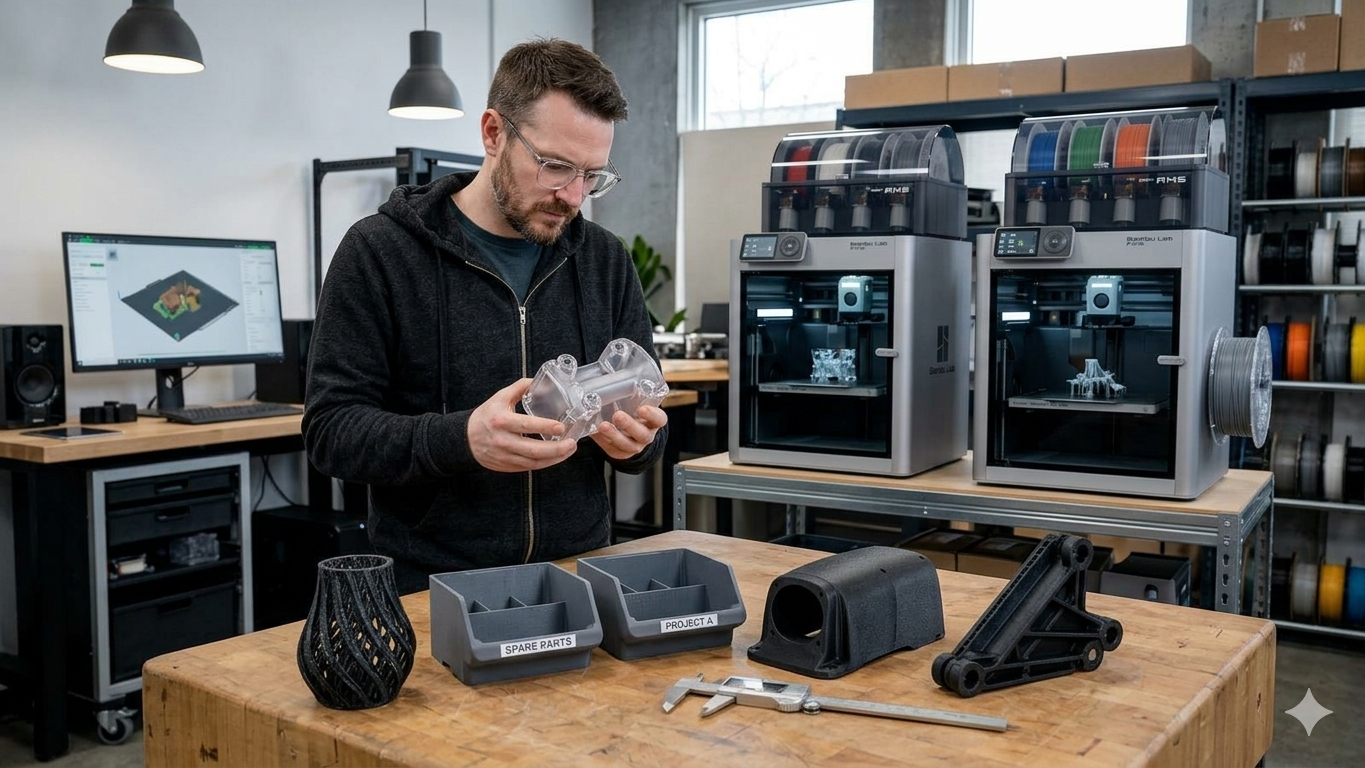
If your business stocks spare parts, you’re paying a cost most owners never put on paper. That bin of brackets, handles, knobs, and replacement plastic pieces sitting in the back room or warehouse isn’t free. For decades businesses just accepted this as the price of being able to fix things quickly, but that math is changing fast.
Fortune 500 manufacturers like Boeing, Daimler, and GE have spent the last decade replacing physical spare parts warehouses with digital inventories, storing parts as CAD files and printing them on demand instead of stocking shelves. Until recently this approach required industrial-grade 3D printers, internal engineering teams, and capital investments far out of reach for small and midsized businesses. That’s no longer true. The same approach is now accessible to marinas, auto shops, fleet operators, restaurants, manufacturers, and property managers across the country, and the businesses that adopt it first are going to have a real advantage over the ones who don’t.
The Cost of Holding Spare Parts
Most business owners look at their parts inventory as money they’ve already spent and stop thinking about it. The actual cost is much higher than the purchase price of those parts. According to NetSuite’s analysis of inventory carrying costs, typical holding costs run between 20 and 30 percent of total inventory value per year, which means a business sitting on $50,000 of spare parts inventory is silently paying somewhere between $10,000 and $15,000 every year in carrying costs they probably never calculate.
That number includes the obvious things like storage space and capital tied up in inventory that isn’t generating revenue, but it also includes parts that become obsolete when equipment models change, parts that get damaged or lost over time, and the labor cost of managing the inventory itself. For a small business operating on tight margins, that’s real money walking out the door for no productive reason.
What Digital Inventory Actually Means
The concept is simpler than it sounds. Instead of storing physical parts on shelves, you store the digital files for those parts in a secure CAD library. When a part is needed, the file is sent to a 3D printer and the part is produced on demand, usually within hours or a few days depending on the size and material. The physical inventory becomes a digital library that takes up no warehouse space, never goes obsolete, and can be updated or redesigned as needed.
For high-volume, fast-moving parts that get used every day, traditional inventory still makes sense. But for the long tail of slow-moving parts, especially specialty items, discontinued components, and parts unique to older equipment, digital inventory is almost always the smarter approach. Most businesses don’t need to print every part, they need to print the right parts, the ones that are rarely needed but absolutely required when they are.
A Real-World Example That Worked
The proof that this approach works at scale comes from companies that have already deployed it. According to Daimler Truck’s official announcement, Daimler Buses now operates a mobile 3D printing center in Hamburg, Germany that produces spare parts on demand inside a 36-square-meter shipping container. As of the announcement, nearly 40,000 bus spare parts had already been made 3D printable. Daimler’s own statement on the benefits is direct: “Decentralised production of parts as required avoids warehousing costs and reduces transportation routes,” and “instead of a wait of several weeks as for conventional spare parts, production and delivery of a 3D printed part takes only a few days.”
Days instead of weeks for parts that customers need urgently, with no warehouse holding those parts in the meantime. That’s the value proposition in one sentence, and it scales down from Daimler’s operation to a small business with twenty commonly-broken parts just as well as it scales up to a global fleet operator. The trade publication 3D Printing Industry covered the launch in detail and noted that this approach is becoming standard across transportation providers including Siemens and Deutsche Bahn for the same reasons.
Who Benefits Most From This Approach
Digital inventory works best for businesses that meet two criteria, they have parts that break or wear out predictably, and the lead time to replace those parts traditionally is painful. Here’s how that plays out across different industries we serve nationwide:
Marinas and boat dealers deal with constant breakage of plastic components like brackets, handle covers, cup holders, switch panels, hatch hinges, and trim pieces, many of which come from manufacturers with long lead times or models that are no longer in production. Building a digital library of the 50 most-replaced parts means next-day to 3-day availability instead of 4 to 8 week waits.
Auto repair shops working on older vehicles run into discontinued interior plastic parts constantly. A digital library of commonly-broken vent covers, knob handles, panel clips, and trim pieces turns “we’ll have to source it” into “we’ll have it this week.”
Restaurant equipment service companies maintain commercial kitchen equipment where small plastic parts (drawer slides, hinges, knob covers, mounting brackets) fail regularly and downtime costs the customer money every hour. On-demand parts production is a real competitive advantage when a restaurant’s prep station is down on a Friday night.
Manufacturers and fabrication shops can replace large portions of their custom tooling inventory (jigs, fixtures, soft jaws, alignment guides, assembly aids) with on-demand 3D printed versions, freeing up tool storage and enabling faster design iteration as production needs change.
Property management companies maintaining HVAC systems, plumbing fixtures, and access hardware across multiple properties can digitize commonly-replaced plastic components and skip the runaround of sourcing obsolete parts from discontinued product lines.
Fleet operators running aging buses, trucks, or industrial vehicles can keep their fleet on the road longer by 3D printing parts the original manufacturer no longer produces.
How the Workflow Actually Works
The process is straightforward once it’s set up. We scan or model the part one time using our industrial 3D scanning equipment, which captures the geometry to within 0.02 mm accuracy, more than precise enough for functional plastic components. The scan becomes a digital file that we store in your secure library, along with material specifications and any production notes specific to that part.
When you need the part printed, you send a quick request, we pull the file, print it in the right material for the application, and ship it anywhere in the US. For customers near our facility in Boynton Beach, Florida, local pickup is also available. Most parts ship within 3 to 7 business days, rush orders in 2 to 3 days. Materials are matched to the use case, ASA for UV-exposed exterior parts, PETG for water and impact resistance, carbon fiber nylon for structural components, polycarbonate for high-heat or high-impact applications.
The first scan does take time and investment up front, but it’s a one-time cost that pays back across every future replacement. Most businesses we work with start with 10 to 20 of their most-replaced parts, see the value, then gradually expand the digital library as they identify more candidates.
Why Domestic Production Matters For This
There’s a reason the businesses doing digital inventory at scale are choosing domestic print partners rather than overseas providers. Speed is the entire value proposition, the moment you build in international shipping, customs delays, and tariff uncertainty, you’ve eliminated most of the advantage. A US-based digital inventory partner delivers in days, an overseas partner delivers in weeks, which is the exact problem digital inventory is supposed to solve.
There’s also a resilience angle that matters when supply chains get stressed. Hurricane season strains every supply chain that depends on long-distance shipping, the same is true for port disruptions, geopolitical tariff shifts, and other supply chain shocks that have become more common over the past few years. A domestic 3D printing partner with your digital files can keep producing parts even when overseas supply chains are disrupted, giving your business a buffer against the kinds of disruptions that catch competitors flat-footed.
We built Superare Prints to serve as exactly this kind of partner for US businesses, no minimums, no tariff exposure, no overseas delays, just rapid on-demand production of the parts you need, when you need them. Whether you’re a marina in the Florida Keys, an auto shop in Ohio, or a manufacturing operation in Texas, the same workflow applies.
If you’re currently sitting on a parts inventory that’s costing more than you realized, we’d love to talk about which items make sense to digitize first. Most businesses see the ROI become clear within the first few replacement cycles.
Get a Free Quote on Your Print →
0 Comments