
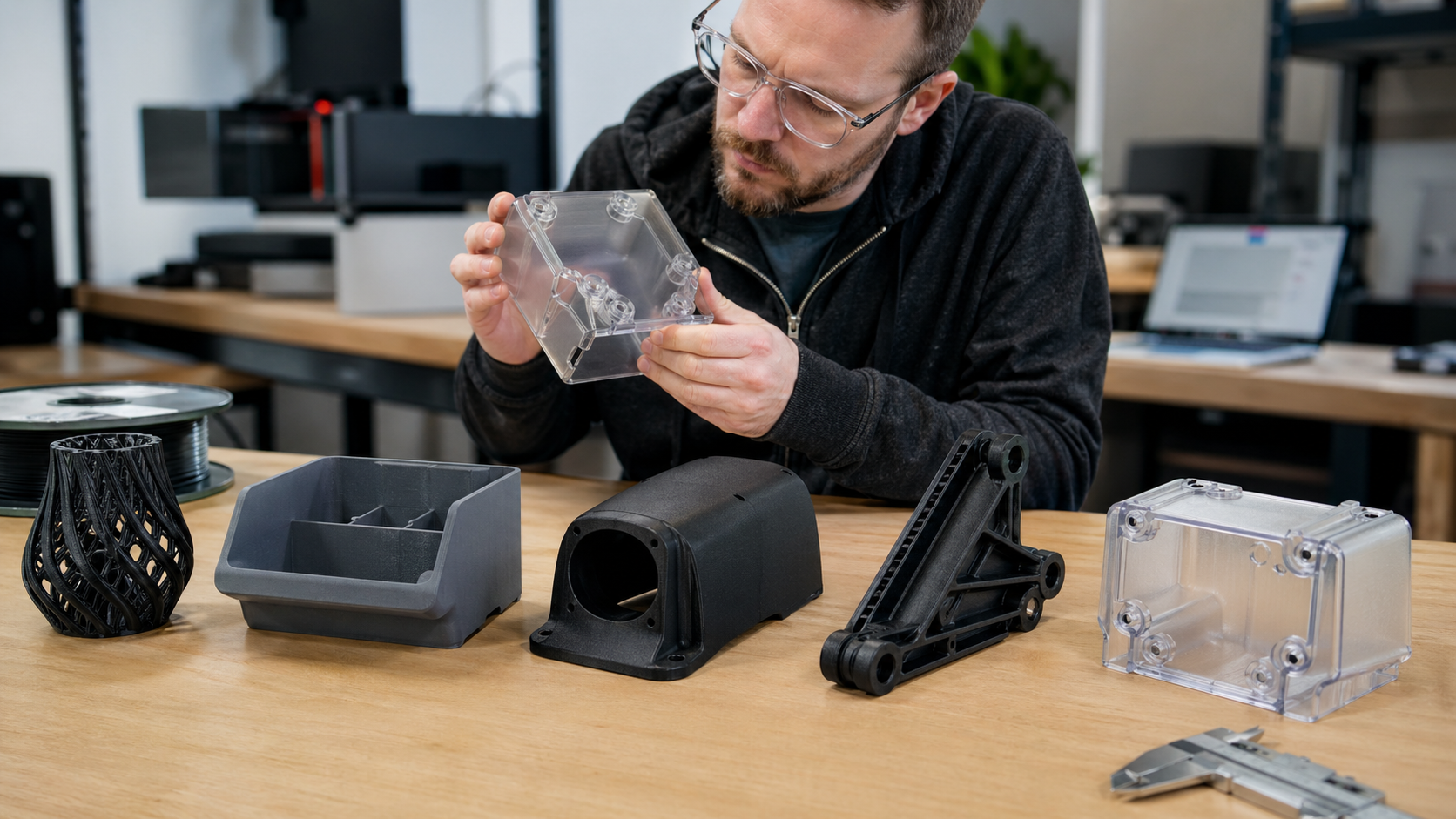
One of the most common mistakes we see in 3D printing orders is choosing a material based on price instead of performance. Someone orders a PLA marine bracket because it’s the cheapest option, it looks identical on the quote, and three months later it’s warped, yellowed, and cracked from UV exposure. Then they reorder in the right material and pay twice.
This guide exists to prevent that. The five materials we print with cover the vast majority of applications, from display prototypes to load-bearing structural components, and knowing which one fits your project before you submit your file saves money, saves time, and gets you a part that actually does what you need it to do.
Why Material Selection Matters More Than Print Settings
People tend to obsess over layer height and print resolution when they first start thinking about 3D printing. Those parameters matter, but material selection is the decision that determines whether your part survives its environment, handles the load it’s designed for, and looks the way you need it to look six months from now.
In South Florida specifically, the environment is actively hostile to the wrong material choices. Sustained UV exposure, salt air from the coast, ambient temperatures that routinely push past 90 degrees in enclosed spaces like sheds, vehicles, and boat compartments, and high humidity year-round will degrade certain materials quickly and leave others completely unaffected. Knowing this upfront shapes every material recommendation we make.
The Five Materials We Print With
PLA — The Right Tool for the Right Job
PLA (polylactic acid) is the most widely used 3D printing material for good reason. It’s affordable, it prints with excellent dimensional accuracy and detail resolution, and it produces clean, professional-looking parts. It’s also the most forgiving in terms of design complexity.
Where PLA works well: visual prototypes, investor demo models, display pieces, interior signage, presentation parts, and anything that won’t see heat, moisture, or extended outdoor exposure. If you’re showing a prototype to a potential licensee or testing a design concept before committing to production materials, PLA is the right call.
Where PLA fails: anything outdoors, anything in a car interior, anything near heat sources, and definitely anything in a marine environment. PLA begins to soften around 60°C (140°F), which in a closed car in July in South Florida is achievable on a cloudy day. It absorbs moisture over time, which causes dimensional creep, and UV exposure will yellow and embrittle it within weeks of outdoor use.
Approximate cost range: $0.08 per gram. A medium-sized part typically runs $15 to $45.
PETG — Our Most Versatile Material and the One We Recommend Most
PETG (polyethylene terephthalate glycol-modified) is what PLA would be if PLA were engineered for the real world. It’s slightly more expensive, it handles UV exposure and moisture without degrading, it’s impact resistant, and it maintains its mechanical properties across a much wider temperature range than PLA.
For South Florida applications, PETG is our baseline recommendation for anything that’s going outside, anything touching water, anything in a vehicle, and most functional mechanical parts. Marine brackets, outdoor signage, boat accessories, enclosures for electronics, irrigation system components — PETG handles all of it without complaint.
It’s also the most practical material for functional prototypes that are going to be tested under real conditions rather than just shown in a conference room. If your prototype needs to actually work, not just look like it works, PETG is almost always the right choice.
Approximate cost range: $0.10 per gram. A medium-sized functional part typically runs $20 to $60.
ASA — When PETG Isn’t Enough
ASA (acrylonitrile styrene acrylate) was developed specifically for permanent outdoor applications. It offers superior UV resistance compared to PETG, better thermal stability, and strong chemical resistance. It’s the material of choice for automotive exterior applications, permanent outdoor installations, and anything that needs to maintain appearance and structural integrity over years of outdoor exposure, not just months.
The performance difference between PETG and ASA outdoors becomes visible over time. After a year of direct sun exposure in South Florida, PETG will show some color shift and minor surface degradation. ASA will look essentially the same as the day it was printed. For one-and-done outdoor installations where replacement isn’t practical, that durability difference justifies the cost premium.
Where we use ASA most often: permanent address numbers and exterior signage, automotive trim and body components, rooftop equipment housings, pool and dock hardware, and any outdoor installation where you need the part to last years without maintenance.
Approximate cost range: $0.15 per gram. A medium outdoor installation part typically runs $30 to $90.
Carbon Fiber Nylon (PAHT-CF) — Engineering-Grade Strength
PAHT-CF (polyamide high-temperature carbon fiber) is a fundamentally different category of material. It’s not a better version of PLA or PETG — it’s an engineering material that happens to be 3D printable, and it’s appropriate for a specific set of demanding applications where other materials simply aren’t strong enough.
The carbon fiber reinforcement in PAHT-CF produces parts with an exceptionally high strength-to-weight ratio, stiffness that rivals aluminum in many configurations, and thermal stability well beyond anything the other materials in this list can match. These are the parts you’d traditionally machine from metal, but that 3D printing can now produce faster and at lower cost for short runs and complex geometries.
Applications we print in PAHT-CF: drone frames, UAV structural components, industrial fixtures and jigs, high-load brackets and mounts, tooling components, and parts that need to handle sustained mechanical stress without creeping or deflecting.
One thing to be clear about: PAHT-CF is significantly more expensive than the other materials on this list, and that cost is justified only when the application actually demands that level of performance. We’ll tell you if a less expensive material will do the job, because recommending PAHT-CF when PETG would work is a waste of your budget.
Approximate cost range: $0.40 per gram. Parts in this material typically run $60 to $300+ depending on size and geometry.
Polycarbonate — Impact Resistance and High Heat
Polycarbonate (PC) is the material of choice when impact resistance and elevated operating temperatures are the primary requirements. It’s the same class of material used in safety equipment, riot shields, and bulletproof glass, and in 3D printed form it retains most of that toughness.
The two scenarios where polycarbonate is the clear answer are applications involving high-impact loads (parts that get hit, dropped, or subjected to repeated shock) and applications involving elevated heat (enclosures near motors or heat sources, parts inside machinery, components that see sustained temperatures above what PETG can handle). For everything else, a less expensive material usually does the job.
Approximate cost range: $0.30 per gram. A medium-sized polycarbonate part typically runs $45 to $150.
The Decision Framework
If you’re not sure which material your project needs, this is the shortest path to the right answer:
Start with the environment. Is this part going outdoors in South Florida? If yes, you’re looking at PETG, ASA, or one of the engineering materials. PLA is off the table. Is it in a marine environment with salt air and water exposure? PETG minimum, ASA if it’s a permanent installation.
Then consider mechanical requirements. Does the part need to handle significant loads, impacts, or sustained stress? PAHT-CF or polycarbonate depending on whether strength or impact resistance is the primary requirement. For most functional parts in moderate-duty applications, PETG handles it.
Finally, consider cost. If the performance requirements can be met by PLA or PETG, there’s no reason to pay for ASA or PAHT-CF. We’d rather help you get a functional, cost-effective part than upsell you into materials you don’t need.
Still not sure? Submit your project details and we’ll make the recommendation. We do this every day, and a five-minute conversation usually lands on the right answer.
One More Thing About Florida Specifically
The material selection conversation looks different in South Florida than it does almost anywhere else in the country. The combination of UV intensity, heat, humidity, and salt air means the margin for error on material selection is narrower here than in temperate climates where a slightly wrong choice might take years to fail instead of months.
We’ve printed parts in this environment, we understand what survives it, and we factor that into every recommendation. If you’re a local business or a Florida boater and you’re not sure whether the material spec you got from an online calculator accounts for actual South Florida conditions, get a second opinion from us before you commit.
Made Locally, No Overseas Hassles
We’re based in Palm Beach County and we serve businesses and individuals across South Florida, Palm Beach, Broward, Miami-Dade, and Martin Counties. Local pickup is available in Boynton Beach and we ship anywhere in the US.
The advantages of working with a local 3D printing shop go beyond convenience, you can actually talk to the people making your parts, you can see physical samples of materials before committing, and when something needs to be adjusted you’re not waiting weeks for a revised shipment from across the Pacific.
We built Superare Prints specifically to give businesses and creators access to rapid product development without the traditional manufacturing runaround, no massive minimums, no tariff surprises, no 8-week lead times and no communication barriers.
Have a product idea you’ve been sitting on? Whether it’s a sketch, an AI image, a broken part that needs recreating, or a fully designed CAD file, we’d love to take a look and show you what’s possible.
0 Comments